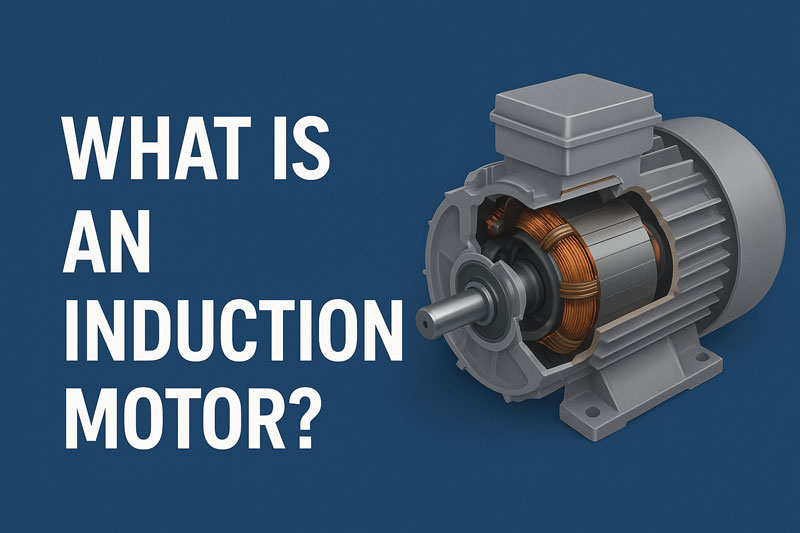
Did you know the induction motor was first patented by Nikola Tesla in 1887? More than 130 years later, induction motors have become one of the most widely used machines in both residential and industrial applications. From powering air conditioners, fans, and pumps to driving heavy-duty equipment like crushers, hoists, and oil extraction mills, induction motors are everywhere.
But how do they work, and which type of induction motor is best for your business or industry? Let’s break it down.
Induction Motor Components
No matter the size or application, all induction motors share the same key components:
-
Case or Housing – Protects the motor from dust, debris, and environmental conditions. Many housings feature cooling fins or vents to reduce heat. Motors can be mounted with frames, plates, or tabs to machinery or concrete bases.
-
Stator – The stationary part of the motor that uses copper windings to generate a rotating magnetic field.
-
Rotor – A cylindrical assembly inside the stator that rotates when induced by the magnetic field. The rotor is mounted on an axle to drive mechanical output.
-
Bearings – Located on each end of the rotor shaft, they reduce friction, improve efficiency, and extend the motor’s lifespan.
Common Induction Motor Housing Types
Depending on the application, induction motors are available in multiple enclosure types:
-
Open Motor
-
Open Drip-Proof Motor (ODP)
-
Screen Protected Drip-Proof Motor (SPDP)
-
Drip-Proof Fully Guarded Motor (DPFG)
-
Splash-Proof Motor
-
Totally Enclosed Motor
-
Totally Enclosed Non-Ventilated (TENV) Motor
-
Totally Enclosed Fan-Cooled (TEFC) Motor
-
Totally Enclosed Blower-Cooled (TEBC) Motor
-
Encapsulated Motor
-
Totally Enclosed Explosion Proof (TEXP) Motor
How Does an Induction Motor Work?
An induction motor works by using alternating current (AC) to create a rotating magnetic field in the stator. This field induces current in the rotor, causing it to spin and produce mechanical motion. The bearings ensure smooth rotation at various speeds and loads.
This simple yet powerful design makes induction motors durable, efficient, and cost-effective for countless applications.
Types of Induction Motors
Induction motors are generally classified into two categories: single-phase and three-phase.
Single-Phase Induction Motors
Used in appliances, pumps, fans, and compressors, single-phase induction motors are compact and efficient but not suitable for heavy-duty industrial applications. Types include:
-
Split Phase – Provides moderate starting torque.
-
Capacitor-Start – Uses a capacitor to improve starting torque.
-
Capacitor-Run – Runs with a capacitor for improved efficiency.
-
Capacitor-Start Capacitor-Run – Uses capacitors on both start and run circuits for maximum performance.
-
Shaded Pole – Simple and reliable, often used in small appliances.
Three-Phase Induction Motors
Ideal for industrial applications, three-phase induction motors deliver higher efficiency and power.
-
Squirrel Cage Induction Motor – Simple, durable, and widely used in conveyors, pumps, and compressors.
-
Slip Ring (Wound Rotor) Induction Motor – Offers greater control over torque and speed, making it ideal for cranes, elevators, and heavy machinery.
Induction Motor Efficiency
The efficiency of an induction motor refers to how effectively it converts electrical energy into mechanical power. High-efficiency motors save energy, reduce operational costs, and minimize environmental impact.
The International Electrotechnical Commission (IEC) classifies motor efficiency into the following categories:
-
IE1 – Standard Efficiency
-
IE2 – High Efficiency
-
IE3 – Premium Efficiency
-
IE4 – Super Premium Efficiency
-
IE5 – Ultra-Premium Efficiency
Choosing a high-efficiency induction motor can significantly reduce energy consumption, especially in industries running motors continuously.
Why Induction Motors Matter
From powering household appliances to driving industrial machines, induction motors remain a cornerstone of modern life. Their versatility, durability, and efficiency make them an essential choice across industries.
When selecting an induction motor for your business, it’s crucial to work with a trusted supplier and service team. This ensures you get the right motor type, proper installation, and ongoing maintenance for long-term performance.