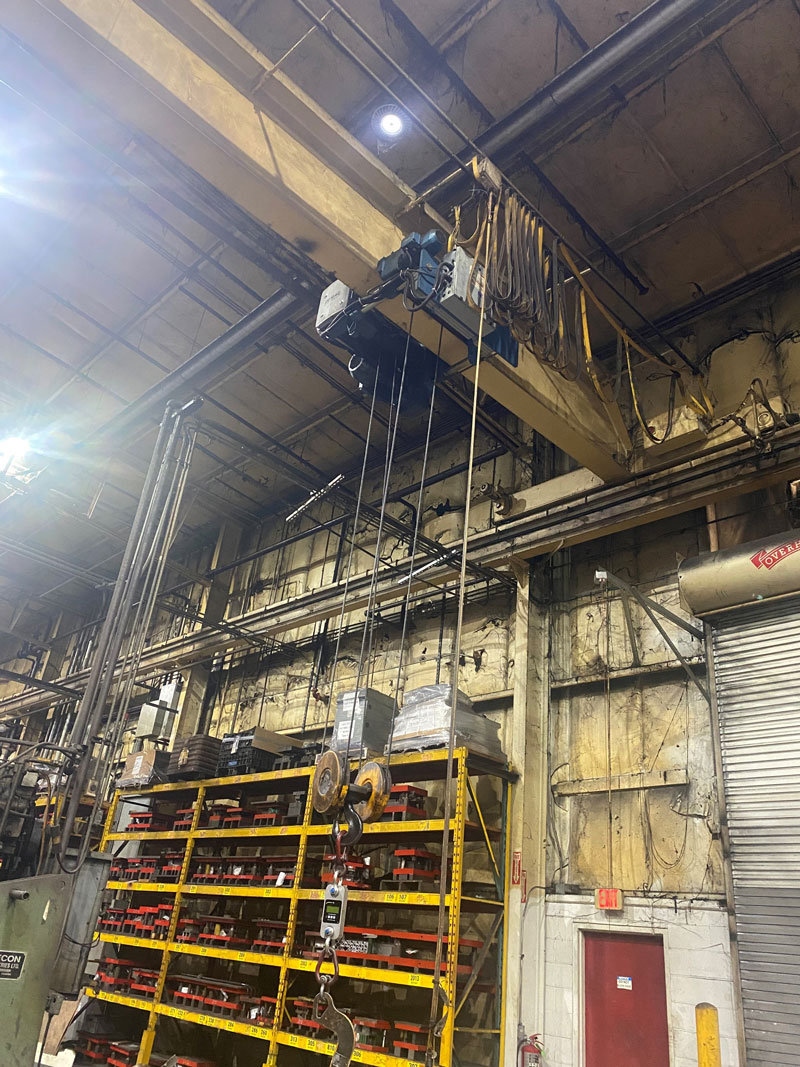
Key Factors for Safety, Performance, and Longevity in Overhead Lifting Applications
Introduction
Selecting the right wire rope for cranes and hoists is crucial for ensuring worker safety, maximizing equipment efficiency, and minimizing downtime. With a wide variety of wire rope types and features available, understanding the essential criteria for selection helps prevent common failures such as overload, slack rope, crushing, and kinking. This guide from Knower Partner, Hi-Speed Industrial Service, will help you make informed decisions when replacing or upgrading wire ropes for your overhead lifting equipment.
Wire Rope Fundamentals
Wire ropes, sometimes referred to as wire cables, are made up of multiple strands of steel wires twisted around a central core. The terms “wire rope” and “wire cable” are often used interchangeably, but technically, wire cables are 3/8” in diameter or less, while wire ropes are larger than 3/8”. Each wire rope is classified by its construction, such as a 7×19 rope, which consists of 7 strands made up of 19 wires each.
Types of Wire Rope Construction
- Regular Lay: Wires are twisted in one direction, while strands are twisted in the opposite direction. This design minimizes kinking and untwisting.
- Lang Lay: Both wires and strands are twisted in the same direction, resulting in increased flexibility and abrasion resistance.
- Alternate Lay: Combines regular and lang lay patterns, maximizing flexibility while reducing the risk of untwisting.
Wire Rope Grades
Wire ropes are manufactured from various grades of steel, each offering different levels of strength and resistance:
- Improved Plow Steel (IPS): Tensile strength ranges from 223 to 258 KSI (kilopounds per square inch).
- Extra Improved Plow Steel (EIPS): 245 to 284 KSI.
- Extra Extra Improved Plow Steel (EEIPS): 269 to 312 KSI.
- Galvanized Improved Steel: Enhanced resistance to corrosion.
- Drawn Galvanized Improved Plow Steel: Superior corrosion resistance and higher tensile strength than standard galvanized wire rope.
If you have questions regarding wire rope grades or KSI ratings, contact Hi-Speed Industrial Service at 800-713-0103 or email for expert guidance.
Key Considerations for Selecting Wire Rope
To ensure optimal safety and performance, consider the following factors when choosing wire rope for cranes and hoists:
- Strength: Evaluate not just the working load, but also dynamic loads resulting from abrupt starts, stops, and high speeds. These loads can significantly exceed the static weight of the lifted object.
- Crushing Resistance: The rope must withstand pressure as it passes over sheaves and drums. Insufficient resistance can cause internal strand deformation and restrict movement.
- Fatigue Resistance: Wire ropes should absorb vibrations and operational shocks without breaking down prematurely.
- Corrosion Resistance: The choice of steel and protective coatings directly affects the rope’s ability to resist rust and environmental degradation.
- Bend Ability: The rope’s ability to recover from repeated bending is essential. Over time, excessive bending can cause outer wires to deform or fracture.
- Metal Loss & Deformation: Watch for wear at drum or sheave contact points and anywhere the rope may rub against surfaces or itself.
- Rotation Resistance: Especially important for hoisting applications where stability and control are critical during lifting operations.
Wire Rope Types for Cranes and Hoists
Wire ropes for lifting generally fall into two main categories:
- Compacted Strand Ropes: Offer increased strength and reduced wear, ideal for heavy-duty use.
- Rotation-Resistant Ropes: Designed to prevent twisting under heavy loads, vital for precise hoisting operations.
Selecting the appropriate type depends on your specific application, required load capacity, and operating environment.
Understanding Rotation-Resistant Wire Rope Categories
Rotation-resistant ropes are further classified based on their strength and rotation resistance:
- Category 1: At least 15 outer strands; highest rotation resistance and strength; can be used with a swivel.
- Category 2: At least 10 outer strands; medium rotation resistance and strength; should not be used with a swivel.
- Category 3: Up to 9 outer strands; lowest rotation resistance and strength; should not be used with a swivel.
Note: According to ASME B30.5, boom hoist ropes must have a design factor of 3.5:1 and a minimum bending ratio of 15:1. Most rotation-resistant ropes do not meet these requirements for boom hoist use.
Wire Rope Finishes and Their Importance
The finish applied to wire rope can significantly affect its durability and performance:
- Bright Finish: Bare high-carbon steel with no additional protective coating.
- Galvanized Finish: Zinc coating to enhance corrosion resistance.
- Zinc-Aluminum Coating: Provides up to three times the corrosion resistance of standard galvanized finishes.
Regular inspections and proper maintenance are essential for maximizing the lifespan and safety of your wire rope.
Conclusion
Choosing the best wire rope for your crane or hoist requires understanding construction types, grades, finishes, and performance characteristics. By carefully considering these factors, you can ensure safe, efficient, and reliable lifting operations. For expert advice and high-quality wire ropes, trust Knower Partner, Hi-Speed Industrial Service, and visit www.knowernetwork.com for more information.