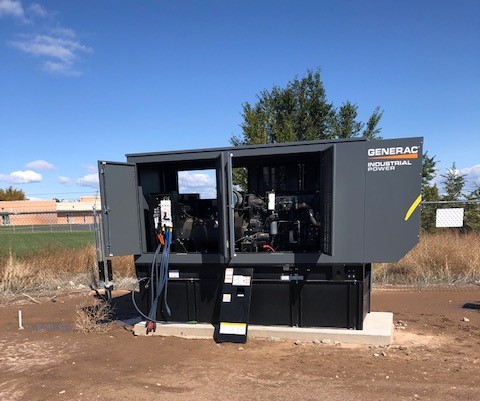
NEC Article 708 outlines strict standards for Critical Operations Power Systems (COPS)—specialized generator systems designed to protect essential facilities during emergencies. Introduced in the 2008 National Electrical Code after the 9/11 terrorist attacks and Hurricane Katrina, this article ensures that facilities critical to national security, public health, and safety remain operational even during catastrophic events.
If your facility has been designated by the Authority Having Jurisdiction (AHJ) as a critical operations area—such as a police station, fire department, emergency call center, data center, hospital, or telecommunications hub—then you must comply with NEC Article 708 requirements.
1. Risk Assessment
A thorough risk assessment is required to identify hazards—both natural disasters and human-caused threats—and evaluate the vulnerability of the electrical system. Once risks are identified, facility operators must develop mitigation strategies to protect against system failures.
2. Security Requirements
Based on the risk assessment, facilities must implement physical security measures. Access to COPS circuits, switchgear, and equipment must be restricted to qualified personnel only to prevent tampering or unauthorized operation.
3. Testing and Maintenance
Proper testing and maintenance are critical to system reliability. NEC Article 708 requires:
-
Initial component and system testing witnessed by the AHJ at installation
-
A commissioning plan to establish baseline performance
-
Periodic testing according to NFPA 110-2019 guidelines
-
Preventive maintenance schedules following NFPA 70B-2019
-
Written or electronic records of all testing and maintenance (no specific retention timeline required)
4. Commissioning Guidelines
At installation, all COPS equipment must undergo:
-
Component and systems testing
-
Documentation of baseline test results
-
A functional performance testing schedule (NEC 708.8)
This ensures long-term reliability and provides reference data for future inspections.
5. Wiring Requirements
COPS wiring must be physically separated from the building’s general wiring. Key NEC Article 708 wiring rules include:
-
Dedicated boxes, enclosures, and receptacles labeled as COPS equipment
-
Indicator lights on receptacles showing active power status
-
Protection against physical damage as specified in NEC 708.10
6. Fuel Supply Standards
Generator systems that rely on utility gas must have a backup fuel source with automatic transfer capability. For internal combustion engines, an on-site fuel supply is required, secured in line with the facility’s risk assessment.
7. Capacity and Redundancy
NEC 708.22 mandates that COPS generators must:
-
Support all critical loads indefinitely
-
Provide a portable, temporary, or redundant power source capable of 72 hours of continuous operation
-
Automatically shed non-critical loads when demand exceeds available capacity
8. Transfer Equipment
COPS require automatic transfer switches (ATS) specifically listed for emergency use. These switches must:
-
Be electrically operated and mechanically held
-
Supply only COPS loads
9. Ground Fault Protection
All COPS systems must include ground fault protection, verified at installation to ensure reliable operation and compliance with NEC safety requirements.
10. Emergency Operations Plan
Every facility operating under NEC Article 708 must maintain a documented emergency operations plan covering:
-
Emergency response procedures
-
Recovery processes
-
Continuity of operations planning
Additional Consideration: Outdoor Gensets
For outdoor generator installations, a separate disconnect switch is not required if the main disconnect is within 50 feet of the building and remains easily accessible.
Final Thoughts
Compliance with NEC Article 708 ensures that Critical Operations Power Systems provide uninterrupted power to the facilities that matter most. From risk assessments and fuel supply to commissioning, testing, and emergency planning, these requirements are designed to safeguard public safety, national security, and critical infrastructure.
By adhering to these standards, facility managers can ensure that their generator systems remain reliable, resilient, and ready for any emergency.