How Vibration Monitoring Can Predict Failures Before They Happen
In today’s competitive industrial landscape, uptime is critical—and predictive maintenance is the secret weapon. One of the most effective tools in a proactive maintenance strategy is vibration analysis. By detecting early warning signs of mechanical issues, vibration analysis allows maintenance teams to intervene before a minor issue becomes a costly, catastrophic failure.
So what exactly is vibration analysis, what does it measure, and how can it benefit your facility or operation? Let’s break it down.
What is Vibration Analysis?
Vibration analysis is the process of measuring and interpreting a machine’s movement to detect irregularities in performance. It’s a cornerstone of predictive maintenance, helping detect faults long before they’re audible or visible.
Here’s the key insight:
By the time a motor makes audible noise, it’s often just 1–4 weeks from critical failure. But subtle changes in vibration patterns can begin up to 9 months earlier.
Using specialized sensors, technicians convert mechanical vibrations into electrical signals. These signals are analyzed to identify patterns that indicate early-stage issues like:
-
Imbalance
-
Misalignment
-
Bearing failure
-
Shaft deformation
-
Gearbox defects
-
Electrical motor faults
-
Mechanical looseness
-
Cavitation or voids in pumps
-
Resonance at critical speeds
These data-driven insights allow teams to make informed maintenance decisions based on real-world equipment behavior—not guesswork.
What Are the Benefits of Vibration Analysis?
Implementing vibration analysis as part of your maintenance program offers multiple advantages:
-
Failure Prediction: Identify equipment issues months in advance, enabling timely repairs before breakdowns occur.
-
Improved Safety: Detecting faults early reduces the risk of hazardous equipment failures.
-
Minimized Downtime: Avoid unexpected outages that halt production and hurt your bottom line.
-
Optimized Maintenance: Schedule repairs during planned downtimes—maximizing labor efficiency and minimizing disruption.
-
Cost Savings: Reduce emergency repair costs and extend the life of your equipment.
-
Peace of Mind: Build trust in your maintenance schedules and operational forecasts.
In short: predictable machines mean predictable revenue.
What Does Vibration Analysis Measure?
Vibration analysis focuses on several key metrics to provide a complete picture of machine health:
1. Acceleration
-
Measures the change in speed of vibration.
-
Emphasizes high-frequency faults (e.g., bearing defects).
-
Often used in early fault detection.
-
Can be converted to velocity or displacement.
2. Velocity
-
Measures the speed of vibration movement.
-
Most commonly used parameter because it relates directly to equipment damage.
-
Balanced sensitivity to both low and high frequencies.
-
Root-mean-square (RMS) velocity is the industry standard for severity assessments.
3. Displacement
-
Measures the distance a part moves during vibration.
-
Focuses on low-frequency issues (e.g., imbalance, misalignment).
-
Best for tracking long-term mechanical wear.
4. Amplitude
-
Reflects the intensity of the vibration.
-
Indicates the severity of the issue.
5. Frequency
-
Shows how often vibration occurs.
-
Helps pinpoint the source of the problem—whether it’s a bearing, motor shaft, or gear tooth.
When is Vibration a Problem?
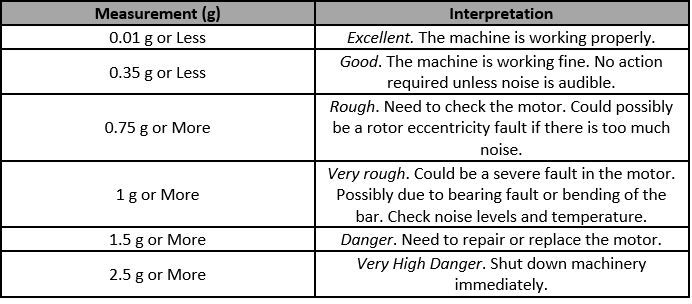
Once data is collected, the key to unlocking its value lies in interpretation. Vibrations are measured on two or three axes (X, Y, Z) depending on the equipment and setup. These measurements are then compared to standard threshold values to assess if—and how urgently—action is required.
Tip: As a starting point, measure vibration across multiple axes and compare the readings to manufacturer-recommended tolerances or ISO vibration severity standards.
Final Thoughts
Vibration analysis is not just for large industrial facilities—it’s becoming increasingly essential for any operation that relies on rotating equipment. By implementing regular vibration monitoring, you’re not just protecting your assets; you’re unlocking a smarter, safer, and more cost-effective way to operate.
Looking to integrate vibration analysis into your maintenance strategy?
Explore expert insights, tools, and vendor-neutral advice at KnowerNetwork.com and get ahead of your next failure—before it happens.