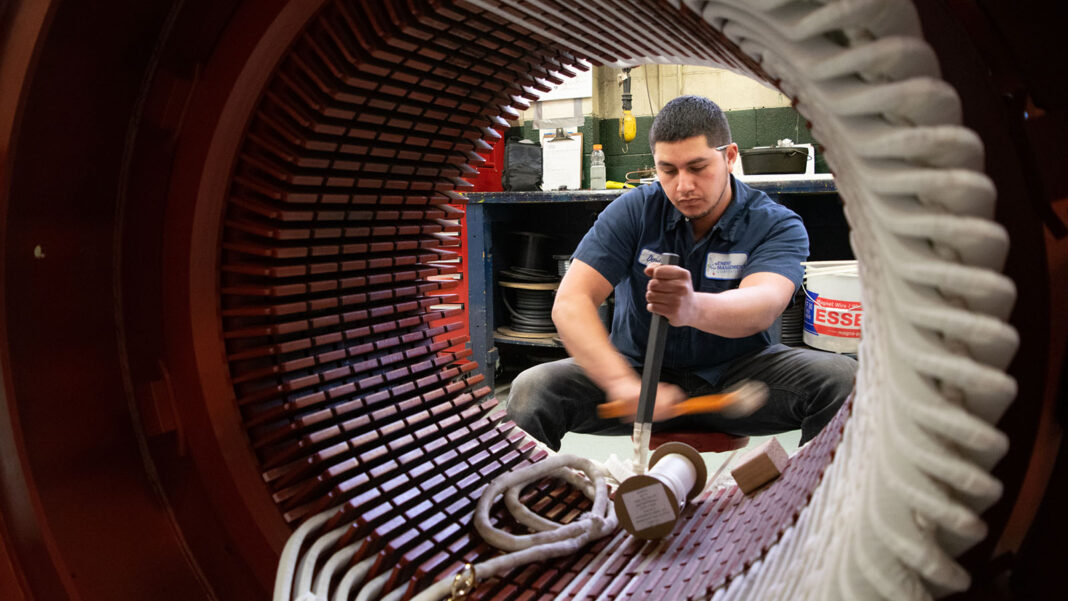
In this second installment of our four-part Motor Shop Spotlight series, we highlight the mechanical inspection, machining, and rewinding processes that ensure electric motors are restored to peak performance. At Energy Management Corporation, our team follows strict industry standards, including ANSI/EASA AR-100, to guarantee accuracy, reliability, and long-lasting results.
Mechanical Inspection: Ensuring Precision and Reliability
Once every motor component has been cleaned and staged, our technicians begin a detailed mechanical inspection to identify damage and confirm tolerances.
-
Visual Inspection – All parts are checked for broken bolts, cracks, or wear. Damage is photographed and recorded in the customer’s service order.
-
Rotor Runout Testing – The rotor is mounted on parallel rollers, and runout measurements are taken from both the shaft and the rotor iron. Results are documented and compared to EASA AR-100 standards.
-
Shaft Measurements – Critical shaft areas, including journals and coupling fits, are measured at six points. Pass/fail is determined against acceptable limits.
-
Bearing Housing Inspection – Using the same six-point measurement practice, housings are evaluated for dimensional integrity. Any issues are photographed and logged for reference.
This careful inspection phase ensures that all future repairs and machining are based on accurate baseline data.
Machining: Restoring Motor Housings, Rotors, and Shafts
When inspection reveals that components are out of tolerance, precision machining restores them to reliable condition.
Housing Repairs
If a motor housing fails tolerance limits, our process includes:
-
Dialing the housing using a dial indicator for accuracy.
-
Machining out old material to prepare for a new sleeve.
-
Cooling the sleeve with liquid nitrogen and installing it with an interference fit.
-
Locking the sleeve in place with industrial retaining compound.
-
Machining the sleeve to final dimensions, recording measurements, and signing off by the machinist.
Shaft and Rotor Repairs
If a shaft dimension is out of tolerance:
-
The shaft is undercut on a lathe to allow weld buildup.
-
It is preheated, then MIG welded to restore material.
-
Post-weld, the shaft is reheated and slowly normalized overnight to prevent stress fractures.
-
Once cooled, the shaft is re-machined to ANSI/EASA AR-100 tolerances.
-
Final dimensions are documented, and the rotor is prepped for painting and balancing.
This process prevents failures and ensures rotors and shafts return to service-ready condition.
Rewinding: Restoring Electrical Performance
When mechanical integrity is confirmed, rewinding may be necessary to restore motor efficiency and extend operational life.
Pre-Rewind Testing
-
Core measurements are taken and analyzed using core-loss software.
-
A core test is performed, and pre-burn data is logged.
-
Motors are prepared for controlled burning in a temperature-regulated oven.
The stator is monitored to ensure burn cycles never exceed 700°F, protecting against lamination damage.
Coil Removal and Core Cleaning
-
Old windings are removed with care to protect iron laminations.
-
The core is blasted with crushed walnut shell media, preventing shorts.
-
Post-core tests confirm that losses remain within EASA accreditation requirements.
Coil Fabrication and Installation
-
Coil specifications are verified using the EASA Verification Database 4.0.
-
New coils are manufactured with precision and stacked for installation.
-
Technicians install coils, insulation, and secure connections.
-
Windings are pre-heated to remove contaminants before entering the Vacuum Pressure Impregnation (VPI) system.
VPI and Final Curing
-
The stator undergoes 1–3 VPI cycles, depending on motor size and voltage.
-
Polyester resin fills voids, improving insulation and longevity.
-
After curing, the stator is baked at 325°F for a minimum of 8 hours.
Final Electrical Testing
Once cooled, the stator undergoes complete testing to ANSI/EASA AR100-2015 standards. Final varnish removal, bore grinding, and mounting preparation complete the process, making the stator ready for reassembly.
Why Precision Motor Rewinding Matters
Rewinding is more than a repair—it’s a chance to restore motor efficiency, extend service life, and maintain compliance with Green Motors incentive programs. When done by certified technicians, rewinding helps reduce operating costs and prevents premature failures.
Final Thoughts
At Energy Management Corporation, we combine expert mechanical inspection, precision machining, and professional rewinding services to bring motors back to life. By following industry best practices and leveraging advanced equipment, we ensure your motors are safe, reliable, and efficient.